What LADWP's 2025 tests found, by water source
LADWP's 2025 drinking water quality report lists total hardness, as calcium carbonate (CaCO3), for each of the plants and well fields that feed the city. Those tests put total hardness at an average of about 103 mg/L in Los Angeles Aqueduct water, about 115 mg/L in LADWP's own well water, and 234 to 236 mg/L in water from the Metropolitan Water District's Weymouth and Diemer treatment plants, with 140 mg/L from its Jensen plant.2
| Water source | Hardness in LADWP's 2025 tests | USGS class |
|---|---|---|
| Los Angeles Aqueduct water | about 103 mg/L | moderately hard |
| LADWP's own well water | about 115 mg/L | moderately hard |
| MWD Jensen plant | about 140 mg/L | hard |
| MWD Weymouth plant | about 234 mg/L | very hard |
| MWD Diemer plant | about 236 mg/L | very hard |
The classes in the right-hand column come from the USGS scale. The hardness in a particular home comes from the source feeding that home.
The USGS scale: moderately hard to very hard
The U.S. Geological Survey has a plain scale for the hardness of drinking water. USGS classes water at 61 to 120 mg/L of calcium carbonate as moderately hard, 121 to 180 as hard, and more than 180 as very hard, with soft water below 61 and anything above 180 considered very hard.1
That scale sorts Los Angeles's own supplies into three bands at once. Aqueduct water sits in the moderately hard band. The Jensen plant's MWD water sits in the hard band. The Weymouth and Diemer plants' MWD water sits in the very hard band, well above the floor of that class.
Where the water comes from, and why hardness varies across the city
LADWP reports that in 2025 the Los Angeles Aqueduct supplied 44 percent of the water that was treated at the Los Angeles Aqueduct Filtration Plant, imported water bought from the Metropolitan Water District was 52 percent, local groundwater 1 percent and recycled water 3 percent,2 and overall over 80 percent of its water is imported.3
Across the service area, LADWP says its Eastern and Harbor communities get Metropolitan Water District water from the State Water Project and the Colorado River Aqueduct, while San Fernando Valley communities get Los Angeles Aqueduct water, local groundwater and State Water Project water, and sources may fluctuate in some communities.2 Hardness varies across the city by water source.
What hard water leaves on glass and chrome
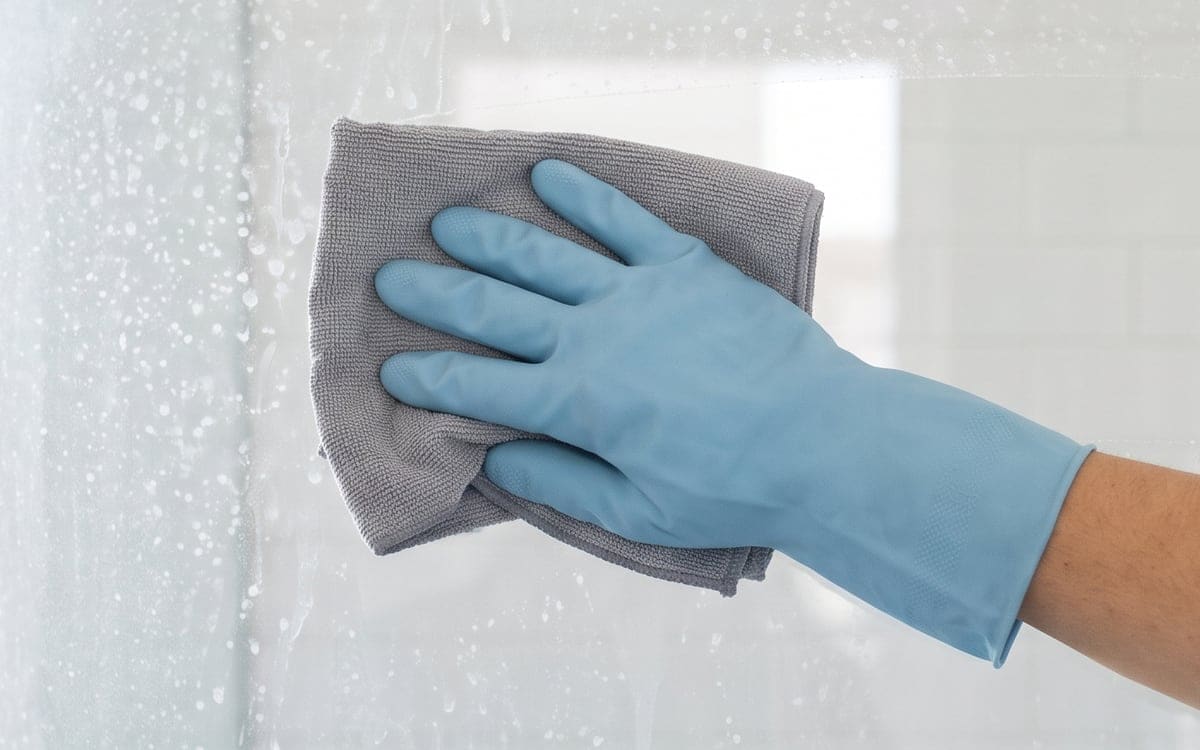
USGS describes the spots or film hard water leaves on glassware as unsightly but not dangerous.1 The marks are a cosmetic problem on a surface.
USGS also says hard water can cause mineral buildup in plumbing, fixtures and water heaters, and that soaps and detergents work less well in it.1
Why hard water stains come back on the same surfaces
The spots come back because new water keeps arriving. A cleaner takes the film off at a visit, and the next shower runs water across the same glass.
That is why hard water work is one of the recurring reaches on a schedule. On a regular maid service visit, the current layer gets wiped at each visit. On a deep clean, the longer-standing film that has built up between visits gets worked over with the time a deep visit allows.
What a cleaner removes, and what etching a cleaner cannot
A cleaner removes the mineral crust from the surface, but cannot reverse etching.
What to tell us on the call
The call sets the picture. Say which room has the marks you want worked over: a master shower, a hall bath tub, the kitchen faucet, more than one. Say how long the marks have been there, or when the glass last looked clear. Say whether the home has a sliding shower door on a tracked frame, a glass panel without a frame, a tub with a curtain, or a walk-in with no door.
A few other details help. Whether the stain is on glass, chrome, brushed nickel, matte black, porcelain or stone. Whether the fixtures are the originals or newer swaps. Whether a water filter or softener is in the line, and where. Whether a prior cleaner has already worked the glass. Whether the household has tried to work the glass before, and with what, so we do not stack a product on top of another one.
Say whether a move-out cleaning is the setting or a regular visit is, since a move-out starts from an empty bathroom and reaches more. Products are never mixed on a visit, and we do not write recipes on a web page.