
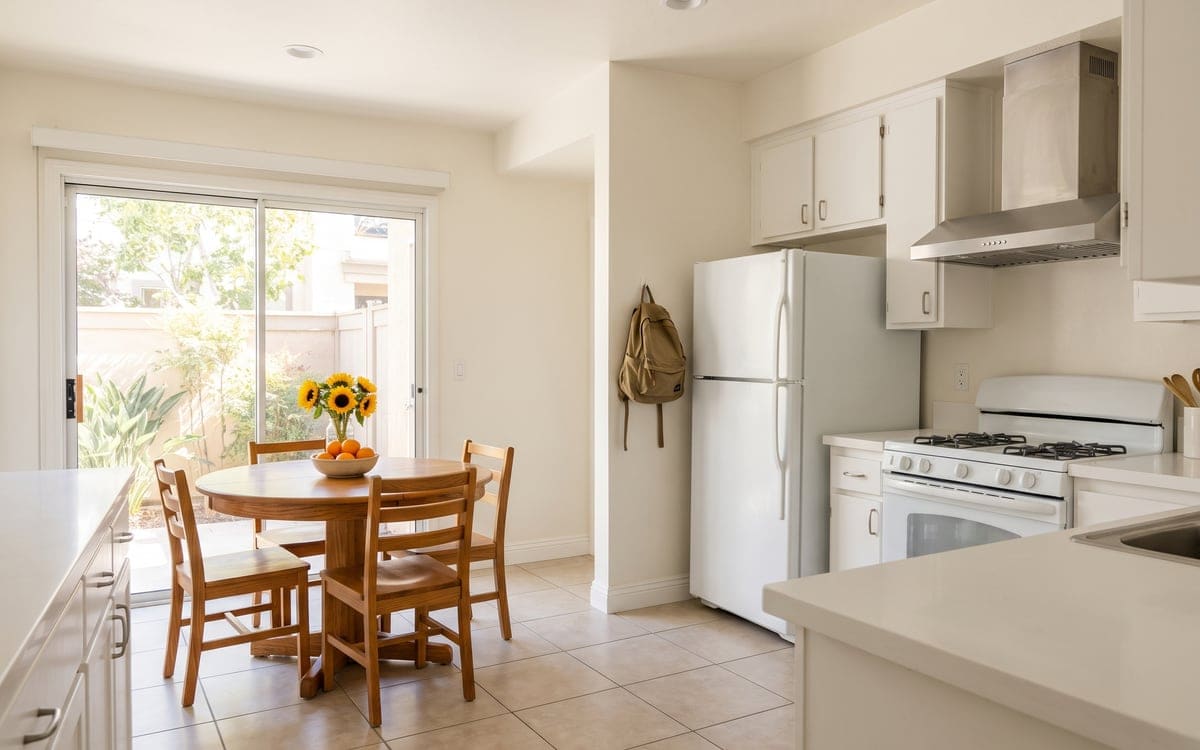
What the home does each day shapes the schedule
Every household accumulates at its own rate. A kitchen that sees serious cooking five nights a week builds up faster than one used mainly for coffee. Two adults who work outside the home all day leave a different residue behind than a household where two children are on the floor from morning to bedtime. A home where someone is present most of the day accumulates differently from one left empty until evening.
Weekly, every other week, monthly
A weekly visit fits a home that accumulates quickly: heavy kitchen use, pets, someone working from home, or a household that wants the place kept at a consistent level. A weekly rhythm keeps the kitchen film and floor dust from reaching a point where a standard visit has to work through backlog.
Every other week suits a one or two-person apartment that uses the kitchen regularly but not intensively; two weeks of daily cooking and foot traffic is a manageable gap.
Monthly suits a lightly used home: a frequent traveler, a small place where the kitchen rarely runs, or a second residence used part of the time. A month of accumulation means the visit has more ground to cover than a two-week gap does. A one-time cleaning service works for households that need the place cleaned occasionally without a recurring commitment.
| Rhythm | Fits a home where | What changes |
|---|---|---|
| Weekly | Heavy kitchen use, shedding pets or a home office | Surfaces reach a visit still in good shape; nothing has had time to layer up |
| Every other week | Moderate use and a small household with no shedding pets | Two weeks of kitchen and bathroom use to work through each visit |
| Monthly | Very light use, a part-time place or frequent travel | More accumulation; the visit covers more ground than the same space on a shorter gap |
Small Los Angeles households
Among the city's 920,674 renter households,1 about 37 percent are one person and about 28 percent are two people. That is a large share of households where the cleaning load stays smaller.
City households average 2.61 people overall, with renter households averaging 2.44.2 A one-person household accumulates less between visits than a four-person one. The kitchen is where the gap shows most. A kitchen used hard most evenings, with grease on the stovetop and film building on the backsplash, fills up at a different rate than one used for coffee and occasional reheating.
Bathroom count matters too. One bathroom means one tub or shower, one toilet, one sink per visit. Two bathrooms doubles that load. Three multiplies it further, even when the household is small.
About 26 percent of the city's 1,439,097 households include someone under 18;3 nearly three in four do not. A household with a young child has a different floor situation and a different countertop situation than one without. That belongs in the description when the call comes.
Pets, roommates and a home office
A shedding dog or cat changes the floor and furniture load.
A roommate adds another person's kitchen use, bathroom use, and floor traffic.
A home office puts someone in the space all day. Surfaces collect what any active space collects over a full day at home, the kitchen runs at odd hours, and the floors get walked more. A weekly cleaning service fits a work-from-home apartment steadily, without letting the accumulation get ahead of what a standard visit can handle.
When a deep clean should come first
A recurring schedule assumes the home is already at a level a standard visit can maintain. If the place has been cleaned less thoroughly for a while, or if there is a backlog in the bathroom or along the baseboards, a deep cleaning service at the start resets the baseline before a regular rhythm begins.
Not every home needs one first. A place already cleaned on a schedule, with surfaces in reasonable shape, can go straight into a recurring pattern without a separate reset visit. A few sentences on the call about when the home was last cleaned thoroughly and where the heavy spots are is enough to figure out which approach fits.
Changing the rhythm later
The rhythm that fit the household may not fit it now. A new dog, someone moving in, a switch to working from home, or fewer people in the apartment all change the picture.
When something shifts, saying so on the next call is enough.
What to say on the call
The useful information: rooms and full bathrooms counted separately. Pets by type and how much they shed. How often the kitchen runs during the week. Whether anyone works from home. When the home was last cleaned thoroughly, and whether any rooms or areas are in heavier shape than the rest.
That picture, given plainly on the call, is enough to talk through a schedule that fits. How the price is shaped goes through how those same inputs affect what a visit costs.